
Exploring the world of Tactical Asset Allocation Strategy, this introduction sets the stage for a deep dive into optimizing investment portfolios with a strategic approach that balances risk and returns effectively.
Detailing the key components and implementation strategies, this overview aims to provide a comprehensive understanding of how Tactical Asset Allocation can enhance investment outcomes.
Introduction to Tactical Asset Allocation Strategy
Tactical Asset Allocation Strategy is a dynamic investment approach that involves adjusting the allocation of assets in a portfolio based on short-term market conditions and trends. Unlike traditional buy-and-hold strategies, tactical asset allocation seeks to capitalize on market opportunities and manage risks by actively shifting investments.
Definition of Tactical Asset Allocation Strategy
Tactical Asset Allocation Strategy involves making strategic changes to the allocation of assets in a portfolio in response to changing market conditions, economic outlook, or specific investment opportunities. This strategy aims to enhance returns and manage risks by taking advantage of short-term market trends.
Purpose of Tactical Asset Allocation Strategy
The primary purpose of Tactical Asset Allocation Strategy is to optimize portfolio performance by adjusting the allocation of assets in response to market fluctuations. By actively monitoring market conditions and making timely adjustments, investors aim to maximize returns and minimize potential losses. This strategy allows investors to capitalize on short-term opportunities and protect their portfolio from downside risks.
Importance of Tactical Asset Allocation Strategy in Investment Portfolios
Tactical Asset Allocation Strategy plays a crucial role in investment portfolios by providing flexibility and adaptability to changing market conditions. This dynamic approach allows investors to react swiftly to market trends, economic indicators, and geopolitical events, thereby optimizing portfolio performance. By incorporating tactical asset allocation into their investment strategy, investors can enhance diversification, manage risks effectively, and potentially achieve better risk-adjusted returns.
Components of Tactical Asset Allocation Strategy
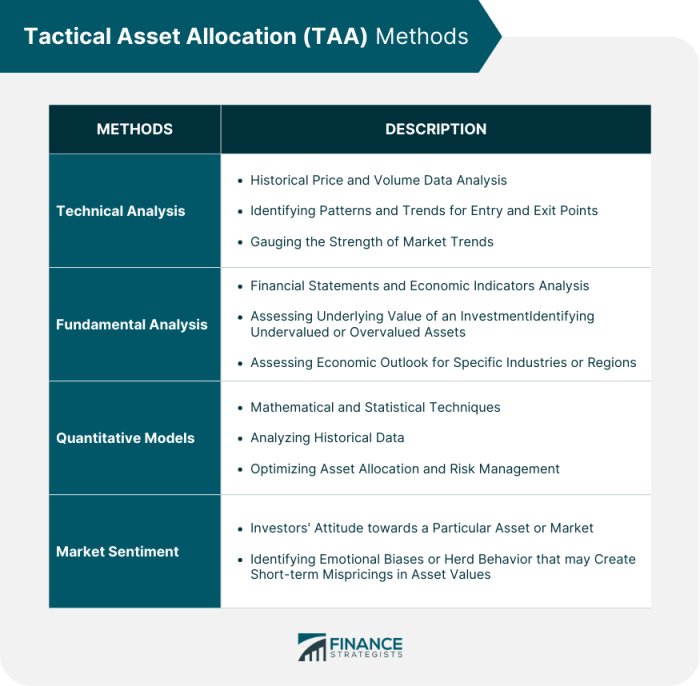
When it comes to Tactical Asset Allocation Strategy, there are several key components that play a crucial role in its effectiveness.
Asset Classes Involved in Tactical Asset Allocation
- Equities: Stocks represent ownership in a company and can offer high returns but also come with higher risk.
- Bonds: Fixed-income securities that provide regular interest payments and are generally considered less risky than equities.
- Commodities: Physical goods like gold, oil, or agricultural products that can act as a hedge against inflation.
- Real Estate: Investments in properties or real estate investment trusts (REITs) that can provide rental income and capital appreciation.
Role of Market Analysis in Tactical Asset Allocation Strategy
Market analysis involves studying various factors such as market trends, investor sentiment, and economic indicators to make informed decisions about asset allocation.
Understanding market conditions allows investors to adjust their portfolio allocations based on the current economic environment.
Impact of Economic Indicators on Tactical Asset Allocation Decisions
Economic indicators, such as GDP growth, inflation rates, and employment data, can significantly influence asset allocation decisions in Tactical Asset Allocation Strategy.
For example, high inflation rates may prompt investors to allocate more resources to commodities as a hedge against rising prices.
Implementing Tactical Asset Allocation Strategy
When it comes to implementing Tactical Asset Allocation (TAA) strategy, several key aspects need to be considered in order to effectively manage the portfolio and achieve the desired outcomes.
Rebalancing Assets in Tactical Asset Allocation
Rebalancing assets is a critical component of TAA as it involves adjusting the allocation of assets in the portfolio to maintain the desired risk-return profile. This process typically involves selling overperforming assets and buying underperforming assets to bring the portfolio back in line with the target allocation.
Significance of Risk Management in Tactical Asset Allocation
Risk management plays a crucial role in TAA as it helps in protecting the portfolio from potential losses during market fluctuations. By carefully monitoring and managing risks, investors can optimize their returns while minimizing potential downside.
Role of Diversification in Implementing Tactical Asset Allocation Strategy
Diversification is key in TAA as it involves spreading investments across different asset classes to reduce overall risk and enhance potential returns. By diversifying the portfolio, investors can mitigate the impact of market volatility on their investments and improve the overall risk-adjusted returns.
Monitoring and Adjusting Tactical Asset Allocation
Monitoring and adjusting a Tactical Asset Allocation strategy is crucial to ensure its effectiveness and alignment with investment goals. Regular assessments and modifications based on changing market conditions are essential for optimizing returns and managing risks.
Methods for Monitoring Performance
Monitoring the performance of Tactical Asset Allocation involves analyzing key metrics and indicators to evaluate how well the strategy is performing. Some methods for monitoring performance include:
- Tracking asset class returns and correlations
- Assessing portfolio volatility and risk levels
- Comparing the strategy’s performance against relevant benchmarks
- Reviewing economic indicators and market trends
Importance of Regular Reviews
Regular reviews in Tactical Asset Allocation are essential to ensure that the strategy remains in line with the investor’s objectives and risk tolerance. By conducting regular reviews, investors can:
- Identify any deviations from the original asset allocation targets
- Adjust the strategy to capitalize on emerging opportunities or mitigate risks
- Rebalance the portfolio to maintain the desired risk-return profile
- Stay informed about changes in market conditions and adjust the strategy accordingly
Adjusting the Strategy Based on Changing Market Conditions
Adjusting a Tactical Asset Allocation strategy based on changing market conditions involves making informed decisions to optimize portfolio performance. Some key steps in adjusting the strategy include:
- Reassessing asset class valuations and outlooks
- Implementing tactical shifts to capitalize on market trends
- Considering macroeconomic factors and geopolitical events
- Maintaining a disciplined approach to avoid emotional decision-making
Investment Advice
When it comes to Tactical Asset Allocation, there are some common investment advice that investors often receive to make informed decisions and optimize their portfolios. Investment advisors play a crucial role in incorporating Tactical Asset Allocation strategies in client portfolios, tailoring them to individual needs and risk profiles. Seeking professional investment advice for Tactical Asset Allocation can offer numerous benefits, including expertise, diversified strategies, and disciplined approach to managing investments.
Common Investment Advice
- Stay informed about market trends and economic indicators to make timely adjustments in asset allocation.
- Diversify your portfolio across different asset classes to reduce risk and enhance returns.
- Regularly review and rebalance your portfolio to align with your investment goals and risk tolerance.
- Consider a long-term investment horizon while implementing Tactical Asset Allocation strategies.
How Investment Advisors Incorporate Tactical Asset Allocation
Investment advisors analyze market conditions, economic outlook, and client’s financial goals to develop a customized Tactical Asset Allocation strategy. They consider factors like risk tolerance, time horizon, and liquidity needs to create a well-balanced portfolio that can adapt to changing market conditions. By actively monitoring the portfolio and making tactical adjustments, advisors aim to optimize returns while managing risk effectively.
Benefits of Seeking Professional Investment Advice
- Access to expertise and specialized knowledge in financial markets.
- Customized strategies tailored to individual goals and risk tolerance.
- Disciplined approach to managing investments and staying focused on long-term objectives.
- Professional monitoring and adjustments to optimize portfolio performance.
Investment Banking in Tactical Asset Allocation
Investment banks play a crucial role in facilitating Tactical Asset Allocation by providing expert advice and services to clients looking to optimize their asset allocation strategies.
Role of Investment Banks
- Investment banks assist clients in analyzing market trends, economic conditions, and investment opportunities to make informed decisions regarding asset allocation.
- They offer research reports, financial modeling, and risk assessment tools to help clients develop effective Tactical Asset Allocation strategies.
- Investment banks also provide access to a wide range of financial products and markets, enabling clients to diversify their portfolios and minimize risks.
Impact of Investment Banking Services
- By leveraging the expertise of investment banks, clients can make more strategic and well-informed decisions when adjusting their asset allocation based on changing market conditions.
- Investment banking services help clients navigate complex financial landscapes and identify opportunities for maximizing returns while managing risks effectively.
- Through tailored advice and personalized solutions, investment banks empower clients to achieve their investment goals and enhance their overall portfolio performance.
Investment Horizon in Tactical Asset Allocation
Investment horizon refers to the length of time an investor plans to hold an investment before selling it. In Tactical Asset Allocation, understanding the investment horizon is crucial as it helps in determining the appropriate mix of assets to achieve the desired financial goals.
Relevance of Investment Horizon in Tactical Asset Allocation
In Tactical Asset Allocation, different investment horizons can significantly influence asset allocation decisions. Short-term investors may focus on more liquid assets to take advantage of immediate market opportunities, while long-term investors may opt for a more diversified portfolio to weather market fluctuations over time.
Aligning Tactical Asset Allocation with Varying Investment Horizons
To align Tactical Asset Allocation with varying investment horizons, investors can consider the following strategies:
- Short-term Horizon: For investors with a short-term horizon, a more active approach to asset allocation may be suitable. This could involve frequent rebalancing of the portfolio to capitalize on short-term market trends.
- Medium-term Horizon: Investors with a medium-term horizon may benefit from a balanced approach, combining both active and passive strategies. This could involve adjusting the asset allocation periodically based on changing market conditions.
- Long-term Horizon: For investors with a long-term horizon, a more passive approach to asset allocation may be appropriate. This could involve setting a strategic asset allocation plan and making minimal adjustments over time to stay on track with long-term financial goals.
Investment Opportunities in Tactical Asset Allocation
When it comes to Tactical Asset Allocation, there are several potential investment opportunities that can be identified and capitalized on. By understanding how to spot emerging trends and opportunities using this strategy, investors can make informed decisions to maximize their returns. Let’s delve into some key points regarding investment opportunities in Tactical Asset Allocation.
Identifying Potential Investment Opportunities
- Market Trends: Analyzing market trends and economic indicators can help identify sectors or asset classes that are poised for growth.
- Global Events: Political events, economic data releases, or geopolitical developments can create investment opportunities in specific regions or industries.
- Technological Advancements: Keeping an eye on emerging technologies and innovation can lead to opportunities in related sectors.
Spotting Emerging Investment Opportunities
- Research and Analysis: Conducting thorough research and analysis can help investors spot emerging opportunities before they become mainstream.
- Monitoring Performance: Regularly monitoring the performance of different asset classes can reveal potential opportunities for reallocation.
- Adapting to Changes: Being flexible and adapting to changing market conditions can help investors take advantage of emerging trends.
Examples of Successful Investment Opportunities
- During a market downturn, reallocating funds to defensive sectors such as utilities or consumer staples can provide stability and potential returns.
- Identifying a growing trend in renewable energy and investing in related companies early on can lead to significant gains as the sector expands.
- Utilizing options or derivatives to hedge against market volatility and capitalize on short-term opportunities can enhance overall portfolio performance.
Investment Strategy Alignment with Tactical Asset Allocation
Incorporating different investment strategies within the Tactical Asset Allocation framework is crucial for optimizing investment returns and managing risks effectively. By aligning various investment strategies with Tactical Asset Allocation, investors can enhance portfolio performance and adapt to changing market conditions.
Impact of Long-Term versus Short-Term Strategies on Tactical Asset Allocation
- Long-term strategies typically focus on fundamental analysis, economic trends, and overall market conditions to make investment decisions. These strategies are essential for establishing a strong foundation for the portfolio and achieving sustained growth over time.
- Short-term strategies, on the other hand, involve more frequent trading, technical analysis, and market timing to capitalize on short-term price movements. While these strategies can generate quick profits, they also introduce higher volatility and risk to the portfolio.
- When aligning long-term and short-term strategies with Tactical Asset Allocation, investors must strike a balance between stability and growth, considering their risk tolerance, investment goals, and time horizon.
Best Practices for Incorporating Various Investment Strategies within the Tactical Asset Allocation Framework
- Diversify across asset classes: Allocate investments across various asset classes, such as equities, fixed income, commodities, and real estate, to reduce correlation risk and enhance portfolio diversification.
- Consider market conditions: Adjust the allocation of assets based on market cycles, economic indicators, and geopolitical events to capitalize on opportunities and mitigate downside risks.
- Rebalance regularly: Monitor the performance of different investment strategies and rebalance the portfolio periodically to maintain the desired asset allocation and risk profile.
- Stay informed: Stay updated on market trends, investment opportunities, and regulatory changes to make informed decisions and adjust the portfolio accordingly.
In conclusion, Tactical Asset Allocation Strategy offers investors a robust framework for making informed investment decisions, adapting to market conditions, and seizing lucrative opportunities with confidence.
FAQ Corner
What is Tactical Asset Allocation Strategy?
Tactical Asset Allocation Strategy involves actively adjusting investments to take advantage of market conditions and maximize returns.
How does risk management play a role in Tactical Asset Allocation?
Risk management is crucial in Tactical Asset Allocation to control potential losses and protect the portfolio from market volatility.
Why is diversification important in implementing Tactical Asset Allocation Strategy?
Diversification helps spread risk across various asset classes, reducing the impact of market fluctuations on the overall portfolio.
What are some common investment advice related to Tactical Asset Allocation?
Common advice includes staying informed about market trends, regularly reviewing portfolio performance, and adjusting allocations based on economic indicators.
How can investment strategies be aligned with Tactical Asset Allocation?
Different investment strategies like value investing, growth investing, or momentum investing can be integrated into Tactical Asset Allocation to achieve specific objectives and enhance overall returns.


